Product
A Number Beside the Roll, Not a Verdict About Your Body
How BRAWLER AI shows your synced wearable workout as raw context beside the session you logged, and why it shows those numbers as recorded instead of turning them into a score.

Your device knows you trained for sixty two minutes and that your heart rate averaged 148. It does not know the second round was against the guy who passes your knee shield every time, or that you finally got the underhook and stood up into a guillotine. It has a number. You have the roll.
What we built, and why it looks like this
The tempting way to close that gap is a verdict. The number becomes a score, the score becomes a color, and by Tuesday a ring on a dashboard is telling you what kind of training day you are allowed to have. That is more confidence than a heart rate sensor earns, especially one strapped under a gi for forty minutes of grip fighting.
So health sync in BRAWLER AI does one thing. It puts the workout your device recorded beside the entry you wrote, as the numbers it recorded. Duration. Calories. Heart rate min, average, max, under the device name and your start time. That is the whole card. No ring, no grade, no adjective.
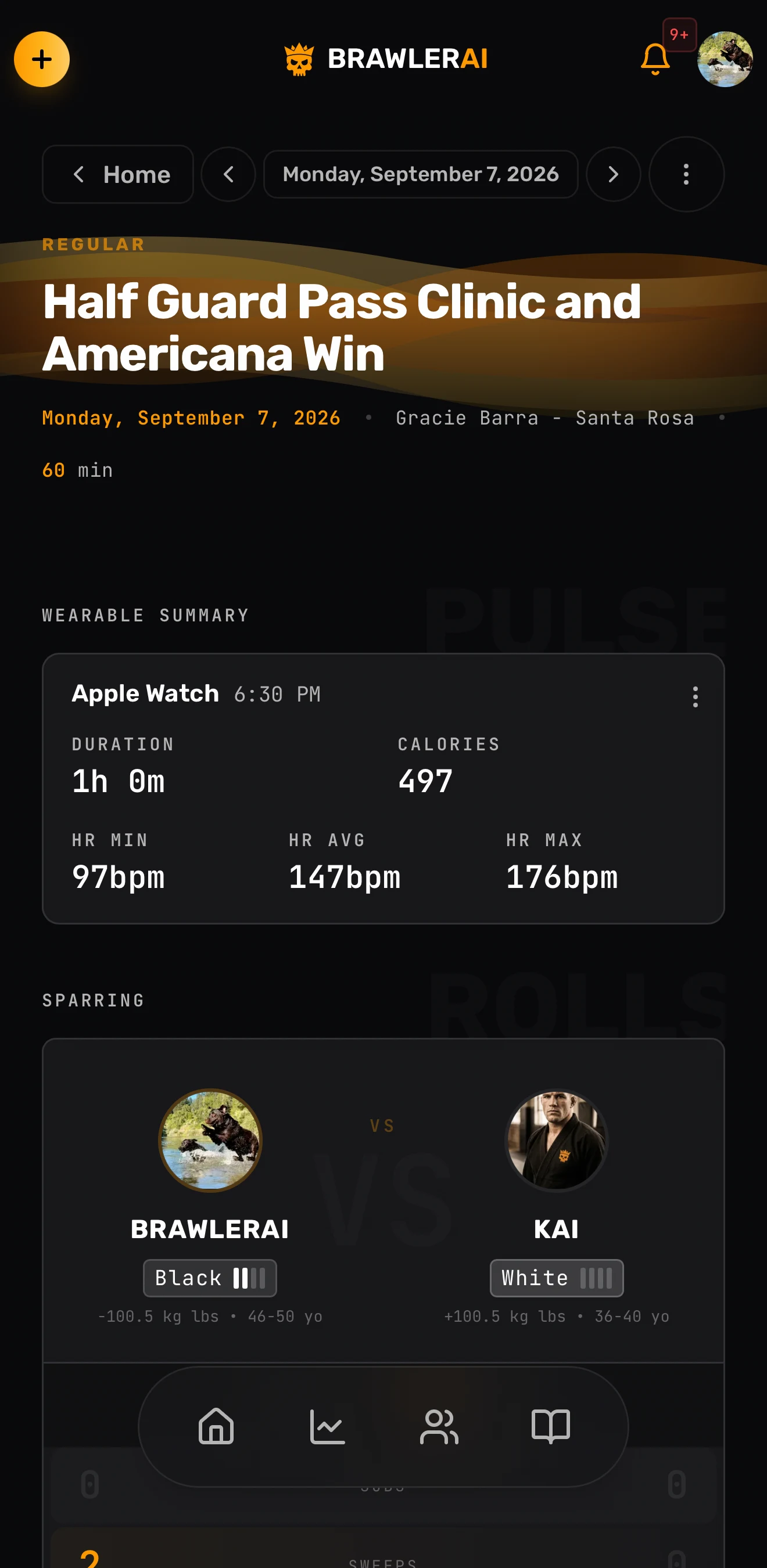
You wrote that your knee shield held for two rounds and then stopped working. That is the thing worth knowing. The 148 average beside it is a detail about that night, the way the gym being freezing is a detail. Worth having, not the story. Calories are the raw figure off the device, not a budget. Two things happened on the same evening, and that is all anyone can honestly say about them, so that is all the app says.
Wearable summaries are training context, nothing more. They are not medical advice, diagnosis, or treatment.
How it works
Sync is optional and off until you turn it on, on your phone. BRAWLER AI does not connect to Garmin or WHOOP or Polar directly. It reads what those apps write into Apple Health or Health Connect, so the tag you pick in your own app is what decides where the workout lands.
A combat sport tag attaches confidently: Martial Arts on Apple Watch, Jiu Jitsu on WHOOP, Martial arts or Judo in Polar Flow, or a session titled jiu-jitsu, BJJ, grappling or judo on Android. A generic tag still attaches, but by date alone, and only if the session ran ten minutes or longer: other, cross training, functional strength, mixed cardio, high intensity intervals, an exercise class. That group is usually where Garmin users land. Running, swimming, cycling and the other named sports never attach at all. You told your device it was a run, and that is the strongest evidence anyone has that it was not jiu-jitsu.
If a summary lands on the wrong entry, Remove detaches it. Resync pulls your workouts again.
If you want the coach to see it
A second setting, also off by default, lets the coach read those summaries. Leave it off and your Brawler Briefs, your coach answers and the Claude and ChatGPT integration never see a heart rate.
Turn it on and a number can show up as one qualifying clause, inside a claim the coach already made from what you logged:
Marcus landed a Waiter Sweep from three-quarter guard bottom, reversing your top position to full mount bottom, in the session where your heart rate ran highest in this range (avg 147 bpm, Apple Watch).
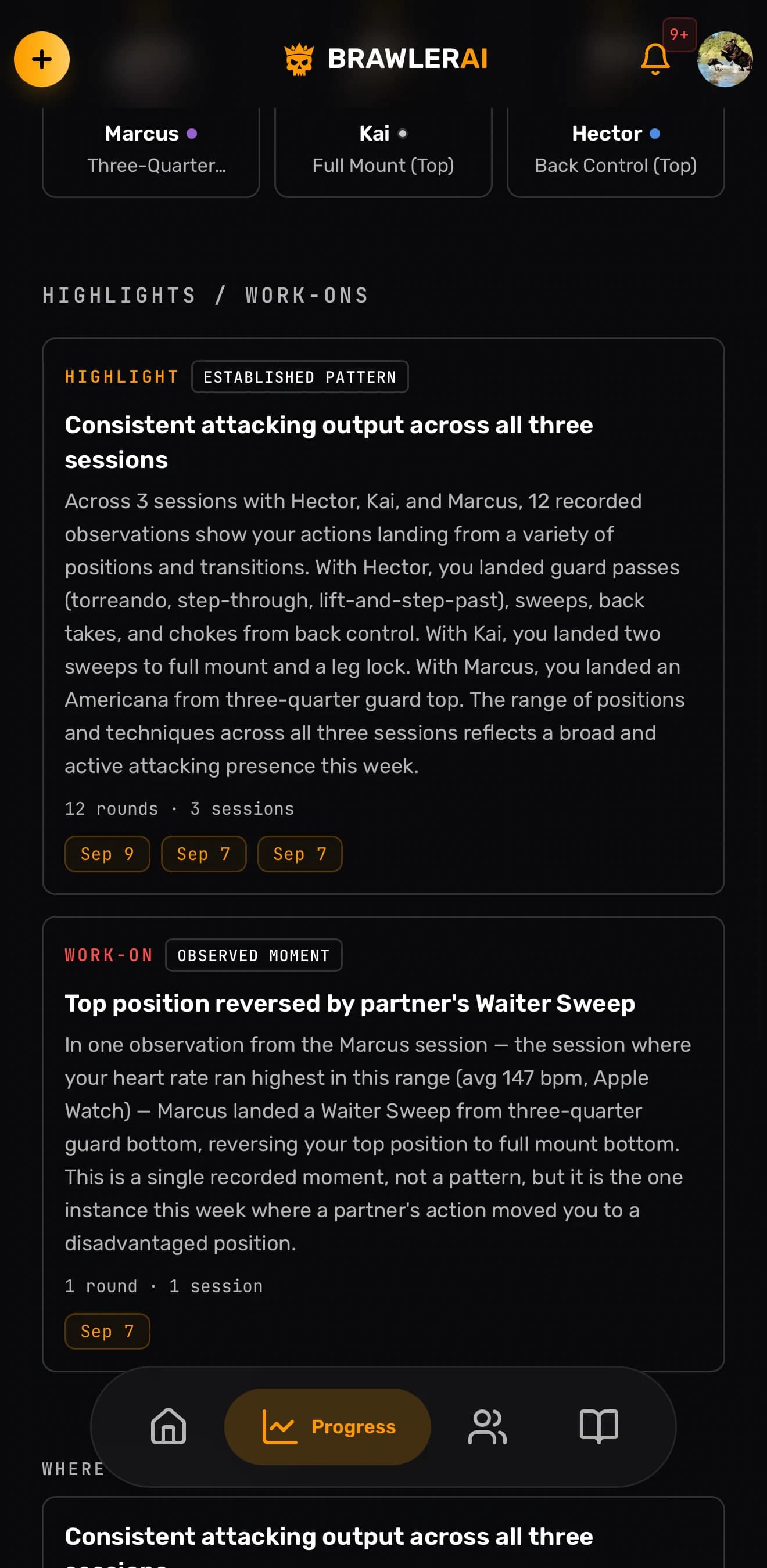
The sweep is the claim, from your own journal. The heart rate qualifies it, sourced to one session and one device, and compared only against your own other sessions. Nothing there says the heart rate caused the sweep. A loose match says so, with "(matched by date only)". Most of the time the number goes unmentioned, because it had nothing useful to add. Turning the setting back off applies to new Briefs and answers, and not the ones already written.
With that setting on, a coach answer sends Anthropic the figures, the device that recorded them, when it started, how we matched it to your entry, and how it ranks against your own other sessions. Connecting ChatGPT sends OpenAI the same set. A Brief sends one sentence composed on our server, never the numbers themselves.
What we read, what we keep and how long we keep it is written out in the privacy policy. The short version: workouts and heart rate only, read and never written back, summarized to min, average and max before we store anything, never sold and never used for advertising. No sleep, no HRV, no resting heart rate, no step counts and no routes. Turning sync off stops future imports without deleting anything you already logged.
Why bother at all
Because a number you can see beside your own words is useful, and a verdict about your body handed down by an app is not.
You already know which session felt heavy. The trouble is that the feeling is in your head, the number is in another app, and what actually happened is in your journal, and those three never meet.
Health sync puts them on the same entry: what you wrote, the rounds you logged, and what your device recorded while you rolled. One night, one place. What it adds up to is still your call.